What Is The Most Scenic Drive In Michigan?
The case for M-37 up Old Mission Peninsula, the honest competition from M-22, Sleeping Bear and the Tunnel of Trees, and the legal catch that separates a scenic drive from a wine-tasting day.
What Is The Most Scenic Drive In Michigan?
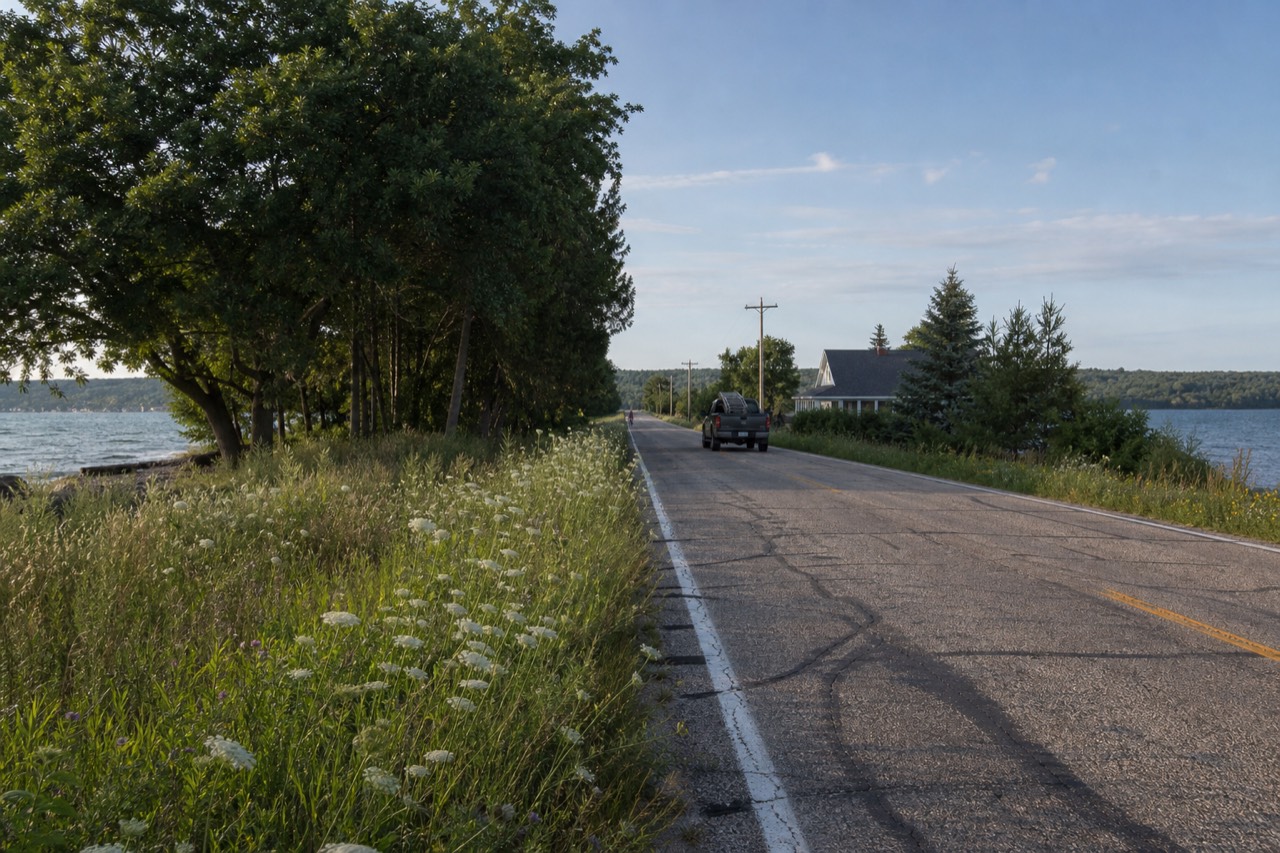
The strongest case is M-37, Center Road, running 19 miles up Old Mission Peninsula north of Traverse City. The peninsula is never more than three miles wide, so for most of the drive water sits on both sides of you, West Grand Traverse Bay on one shore and East Grand Traverse Bay on the other, and wineries throughout.
That geography is the whole argument. Most celebrated drives in America earn their reputation on one side of the car: a coastline to the west, a canyon wall to the east. Center Road does not make you choose. The peninsula it runs along is a glacial ridge pushed between two arms of Grand Traverse Bay, and the regulation that created the Old Mission Peninsula American Viticultural Area in 1987 describes the boundary as proceeding north 19 miles along the western shoreline to the lighthouse at Old Mission Point. The road follows roughly that line, from the edge of Traverse City to the tip.
What you get is a drive that changes character three or four times in under half an hour. It starts in orchard country, cherry and apple blocks rolling away on both sides. It climbs through the narrow waist of the peninsula where, on a clear day, you can see both bays at once. It passes the working vineyards of the ten wineries on the Old Mission Peninsula Wine Trail. And it ends at Mission Point Lighthouse at the 45th parallel, halfway between the equator and the North Pole, where the two bays meet around a gravel spit you can walk out on.
The competition is real, and this article gives it a fair hearing below. But the honest answer to the question is that no other route in Michigan, and few anywhere in the country, keeps a two-water view alive for so many consecutive miles. The bay-modified air that makes the peninsula wine country is the same force that keeps the roadside green into late summer, and it is the reason the drive pairs so naturally with tasting rooms. If you want the full picture of the region's roads and wineries, the wine country map guide lays out both peninsulas stop by stop.
Why M-37 Up Old Mission Makes The Strongest Case
M-37 wins on a simple piece of geography: the road runs the spine of a peninsula that is no more than three miles wide at any point, so the water is never far away on either side. No other Michigan route keeps a two-water view for so many consecutive miles.
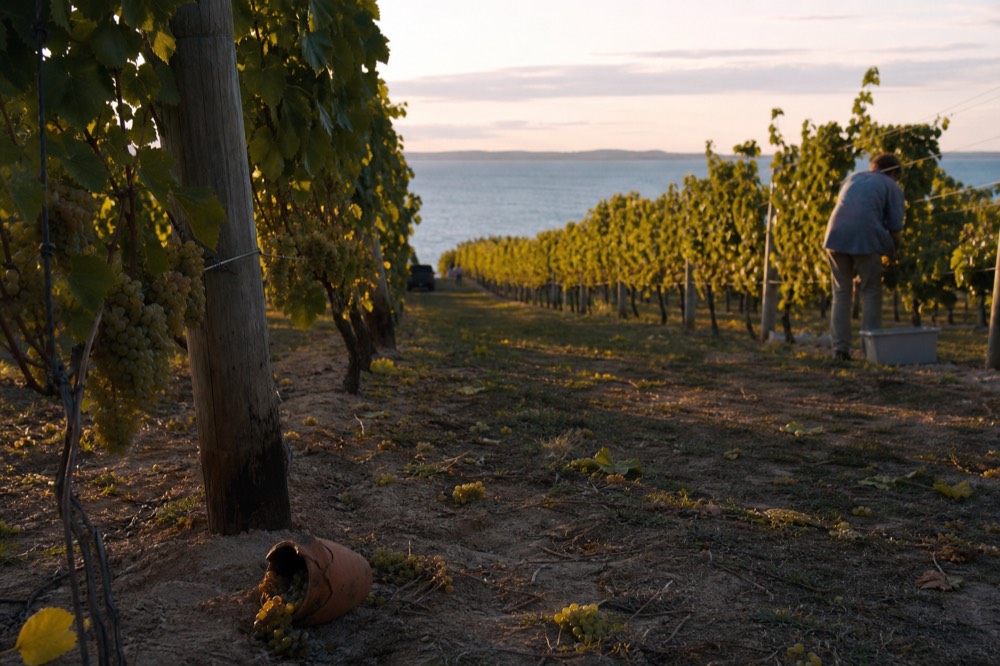
Start with the numbers, because they are unusually well documented. The Old Mission Peninsula AVA, established by federal regulation in 1987, covers about 19,200 acres, and the peninsula itself is no more than three miles wide at any point, running roughly 19 miles north from Traverse City to the lighthouse near Old Mission Point. Center Road, signed as M-37, is the single spine of that landmass. There is no alternate route, no bypass, no second road along the other shore. Every drive up Old Mission is the same drive, and it is a good one.
That singularity matters in a practical way too. In July 2026 a culvert collapsed on Center Road near Council Oaks Drive, and the temporary repair that reopened it came with instructions to stay off the shoulder. The incident was transient, but it proved the structural point: when something happens to M-37, the peninsula has no plan B. A road that carries all the traffic of a wine region, an orchard economy and a state park at the tip, and still feels quiet, is doing something right.
The drive also has a rhythm the bigger named routes lack. You are never more than a few minutes from a place to stop: a winery tasting room, a farm market, a beach access, the Old Mission General Store in the tiny unincorporated village at the peninsula's heart. The Tunnel of Trees is a corridor; Sleeping Bear is a destination at the end of a road. Old Mission is a place you drive through and keep wanting to pull over in, which is arguably the definition of a great scenic drive.
There is one more argument, and it is the one this site exists to make. Traverse City sits on the 45th parallel, the same latitude band as parts of Bordeaux and Piedmont, and the lake-moderated climate of the two peninsulas produces over 60% of Michigan's grapes, according to Traverse City Tourism. M-37 is one of the only scenic drives in the state where the scenery is the agriculture. The vineyards you pass are not decoration; they are the reason the wine region exists. For more on that story, see why so many vineyards grow here.
The Honest Competition: How The Other Famous Routes Compare
The Leelanau loop on M-22 and M-204, the Pierce Stocking Scenic Drive at Sleeping Bear Dunes, and the Tunnel of Trees near Harbor Springs are the real rivals. Each beats M-37 on one dimension, dunes, forest canopy or variety, and none matches its sustained water-on-both-sides effect.
M-22 deserves to be taken seriously, and most Michiganders would name it first. It wraps the Leelanau Peninsula, threading through Suttons Bay, Northport, Leland and Glen Arbor, with Sleeping Bear Dunes National Lakeshore along the western stretch. It is longer, more varied and passes through actual towns rather than one hamlet. A ribbon-cutting on 8 March 2026 marked the finish of a $25.8 million reconstruction of the M-72 and M-22 approach into Traverse City, so the drive out of the city toward Leelanau is now smooth new pavement with a new roundabout, as Leelanau News reported. In May 2026 a stretch of M-22 crossing Grand Traverse Band land was also dedicated as the Company K Indian Veterans 1st Michigan Sharpshooters Civil War Memorial Highway, honoring Native Civil War soldiers, which adds a layer of history the Old Mission drive cannot match.
| Route | Length | Roughly, drive time without stops | What you see | Where to stop |
|---|---|---|---|---|
| M-37 / Center Road, Old Mission Peninsula | About 19 miles one way | 35 to 45 minutes | Two bays, vineyards, orchards, lighthouse at the 45th parallel | Ten wine trail wineries, Old Mission Point park, Haserot Beach |
| M-22 and M-204 Leelanau loop | Roughly 100 miles full loop | 3 to 4 hours | Lake Michigan shoreline, dunes, harbor towns, farmland | Suttons Bay, Northport, Leland's Fishtown, Glen Arbor, 20-plus wineries |
| Pierce Stocking Scenic Drive, Sleeping Bear Dunes | A short loop drive | 30 minutes to an hour with overlooks | Perched dunes high above Lake Michigan, forest | Overlooks 9 and 10, the Dune Climb, Glen Lake views |
| Tunnel of Trees, Harbor Springs to Cross Village | About 27 miles | Under an hour | Dense hardwood canopy hugging the Lake Michigan bluff | Good Hart General Store, Pond Hill Farm, Harbor Springs |
The Pierce Stocking Scenic Drive is the purest single payoff on the list. It is short, a loop inside Sleeping Bear Dunes National Lakeshore, and its overlooks put you on top of perched dunes high above Lake Michigan. The National Park Service notes it is open to vehicles roughly late May until late October, weather depending, and closed to cars but open to walkers outside that window, so it is a seasonal experience in a way M-37 is not. Check the park's own scenic drive page before you go.
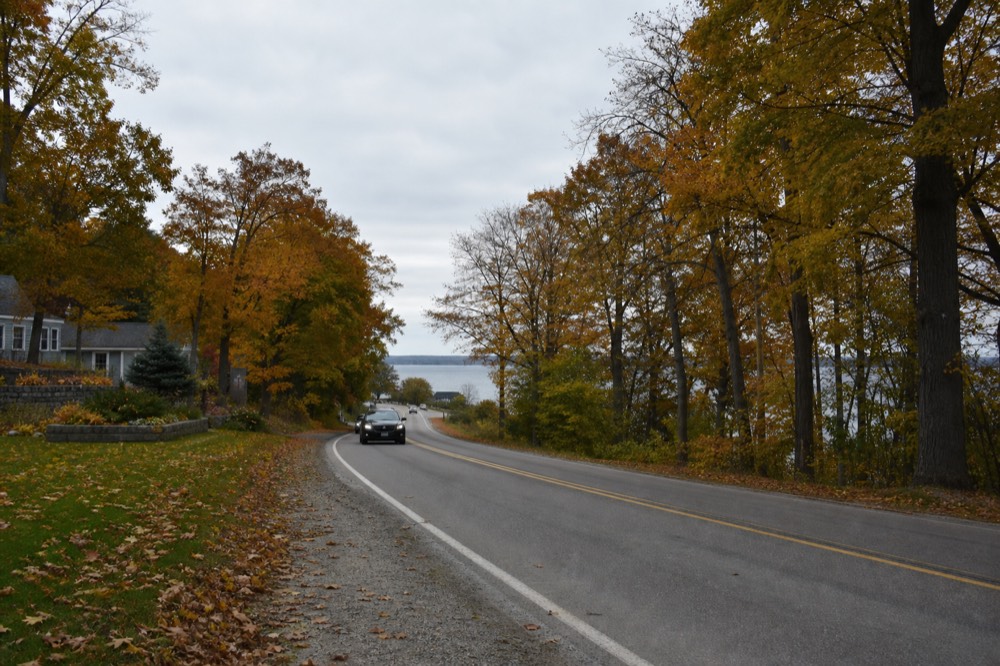
The Tunnel of Trees, meanwhile, wins on intimacy. The route north of Harbor Springs narrows to a single lane in places, with hardwoods meeting over the road and the lake glimpsed through the trunks. It is at its best in fall colour, and it is the one route here with essentially no wine connection, being on the Little Traverse side of the state near Petoskey. If you are weighing a trip that pairs wine country with the Tunnel of Trees, the Traverse City or Petoskey comparison covers both bases.
One practical note that most scenic-drive write-ups miss: there was no ferry service to North or South Manitou Island at all in the 2026 season, because the National Park Service closed both island docks for reconstruction, and service is expected to resume in 2027. Plenty of older Leelanau itineraries still tell you to hop the ferry out of Leland. Plan around it.
Where The Wine Stops Sit On Each Route
Every major scenic route in northwest Lower Michigan passes working wine country. Old Mission puts ten wineries on M-37 itself, the Leelanau loop threads past the trail's member tasting rooms, and a wine stop is a natural add-on on all of them, provided somebody in the car is not the one tasting.
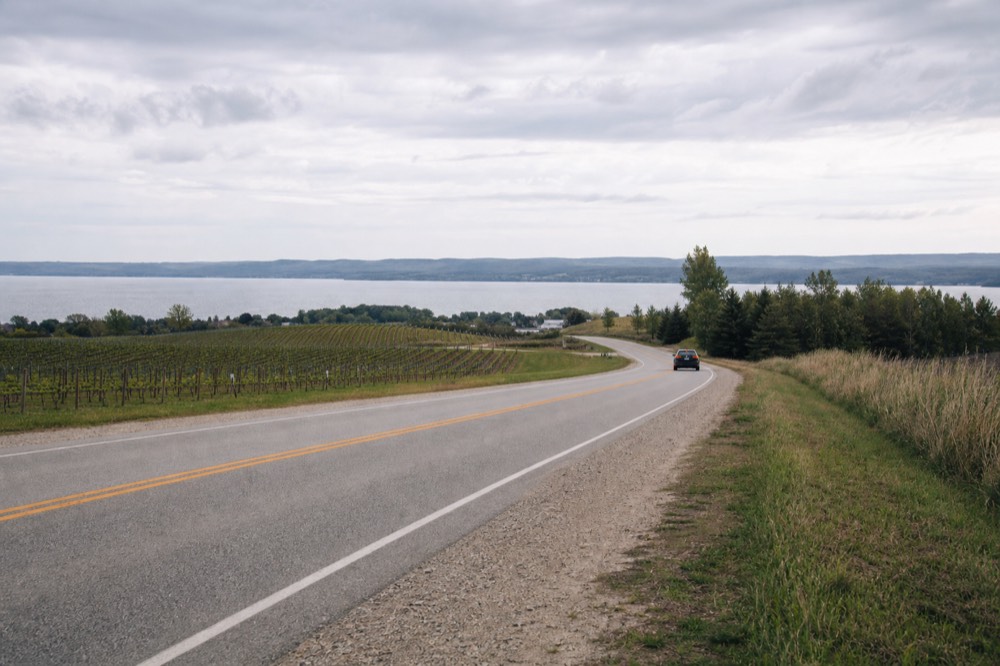
This is where the Old Mission drive pulls away from the field for a wine-minded traveler. The Old Mission Peninsula Wine Trail's own map lists ten wineries, and they sit directly on or just off Center Road. A Leelanau loop passes more tasting rooms in total, the trail describes itself as over 20 award winning wineries, but they are spread across a hundred miles of driving rather than nineteen. On Old Mission you can visit three or four rooms without ever being more than ten minutes from the road you are already on.
| Route | Wine stops on or near the route | Realistic tasting plan |
|---|---|---|
| M-37, Old Mission | Ten wine trail wineries along 19 miles | Three or four stops in an afternoon; a shared five-hour shuttle tour from $79 per person covers four, with tasting fees of about $5 to $10 paid at each bar |
| M-22 / M-204, Leelanau | The Leelanau trail's member wineries across the loop | Pick one arm of the peninsula; a five-hour shared tour from $79 per person visits three estates with appointments arranged ahead |
| Pierce Stocking Scenic Drive | None inside the lakeshore; Leelanau wineries on the drive out | Pair with a Glen Arbor or Suttons Bay tasting room before or after |
| Tunnel of Trees | Essentially none; this is not wine country | Treat it as a colour drive, not a tasting day |
The fee structure is the part worth knowing before you budget. Shuttle-style tours on both peninsulas generally cover transport only, with tasting fees paid at each winery, roughly $5 to $10 per tasting on Old Mission and $5 to $15 on Leelanau. The small-vehicle operators include samples and a complimentary bottle in the ticket, with flights and food extra. The full breakdown, winery by winery, is in the wine tour prices guide.
There is also a way to see the peninsula at bicycle pace. A bike-and-wine tour on Old Mission runs four and a half hours with a support vehicle along, from $199 covering two riders, which turns Center Road from a drive into a slow roll past the same vineyards. For travelers who would rather not pedal or drive, the shared shuttle runs the same road daily in season.
The Legal Catch: A Scenic Wine Drive Is Not A Tasting Day
Michigan's open-container law, MCL 257.624a, bans open alcohol in a vehicle's passenger area, with an exception for passengers in a chartered vehicle authorized by the state transportation department. The OWI threshold is 0.08. So a self-drive scenic wine route and a guided tasting day are legally different products, not just different prices.
This is the distinction almost every scenic-drive article ignores, and it matters more here than anywhere else in Michigan, because the most scenic drive in the state is also a wine trail. The statute is explicit. Subsection (1) bans transporting or possessing open alcohol in the passenger area of a vehicle, a misdemeanour under subsection (3). Subsection (4) is the exception: the section does not apply to a passenger in a chartered vehicle authorized to operate by the state transportation department. That carve-out is why the chartered shuttle and SUV operators can advertise drinking on board, and it does not extend to a private car.
The practical arithmetic is blunt. A driver who tastes is a driver who cannot drive. Michigan's operating-while-intoxicated threshold is 0.08 grams per 100 milliliters of blood, with a zero-tolerance rule of 0.02 or any presence of alcohol for anyone under 21, and every wine tour listing in the region states it is not suitable for under-21s. Tasting pours are small, but three or four rooms add up, and the drive home from Old Mission Point is 19 miles of the same winding road you came up on.
That is exactly why the designated-driver product exists, and it is the cleanest way to turn the most scenic drive in Michigan into a full tasting day. A hired driver from Bay Life Getaways takes the wheel of your own car for five hours, on a route of your choosing on either peninsula, and the from-price of $369 covers the whole group with tasting fees paid at each winery. You get the drive, the views and the pours, and nobody in your party spends the afternoon sipping water. The broader options, from shared shuttles to private SUVs, are compared in the wine tour transport guide.
One honest caveat on the drive-your-own-car format: because it is your vehicle and not a chartered one, the open-container exception does not apply. Sealed bottles belong in the trunk or stowed per the statute, not in the cupholders, and the driver's day ends when the tasting begins. The trade is flexibility, your route, your pace, your wineries, against a stricter legal line.
When To Drive It: Fall Colour And The Seasons
Fall is the peak season and the forecasts for 2026 disagree: one outlet projected northern Lower Peninsula colour around 20 October, another put the Leelanau peak at 7 to 13 October, and Traverse City Tourism advises early to mid October, with the peninsulas holding colour later than inland areas.
The disagreement between forecasters is itself useful, because it reflects real year-to-year variance. What is consistent is the mechanism: air off Lake Michigan keeps the peninsulas insulated, so their colour often lingers to the end of October after inland areas have gone bare. The same bay moderation that extends the growing season for grapes extends the colour season for maples, which is a neat piece of physics for a wine-region drive. The Detroit Free Press published its 2026 foliage forecast in August, and Traverse City Tourism maintains its own colour tour guidance with the bay-effect explanation.
October is also the busiest month in the tasting rooms, because harvest and fall colour land at the same time. Harvest runs mid to late September through October, with Riesling picked latest, and ice wine grapes left on the vine into late December and January. If you want the scenic drive with the fewest crowds and still-green vines, June and July give you long light and orchard country in full leaf. If you want the full postcard, aim for the first half of October and book tasting appointments ahead. The full seasonal breakdown is in when to go wine tasting, and a dedicated colour-route itinerary is in the fall colors route piece.
How To Build The Drive Into A Day
The cleanest plan is M-37 out of Traverse City with three winery stops and the lighthouse at the end, done either early with a driver hired for the day or split so the tasting happens at the last stop. Allow five hours minimum; the full loop with a lunch stop runs closer to seven.
Direction matters less than timing. Going north first puts the lighthouse and the narrow tip at the far end, which makes a natural turnaround, and the return leg south gives you the West Bay side of the road for the drive back toward town. Most of the tasting rooms sit in the middle third of the peninsula, so a sensible shape is one stop on the way up, the point at the top, and two stops on the way down.
If you would rather not plan any of it, the structured options all run this same road. The shared five-hour shuttle visits four wineries from $79 per person plus tasting fees, the semi-private SUV tours from $69 include samples and a bottle, and the private formats, from the two-person Escalade run to the fourteen-guest group charter, let a party set its own stops. The self-guided wine tour guide covers the build-it-yourself version, including which rooms take walk-ins and which prefer appointments.
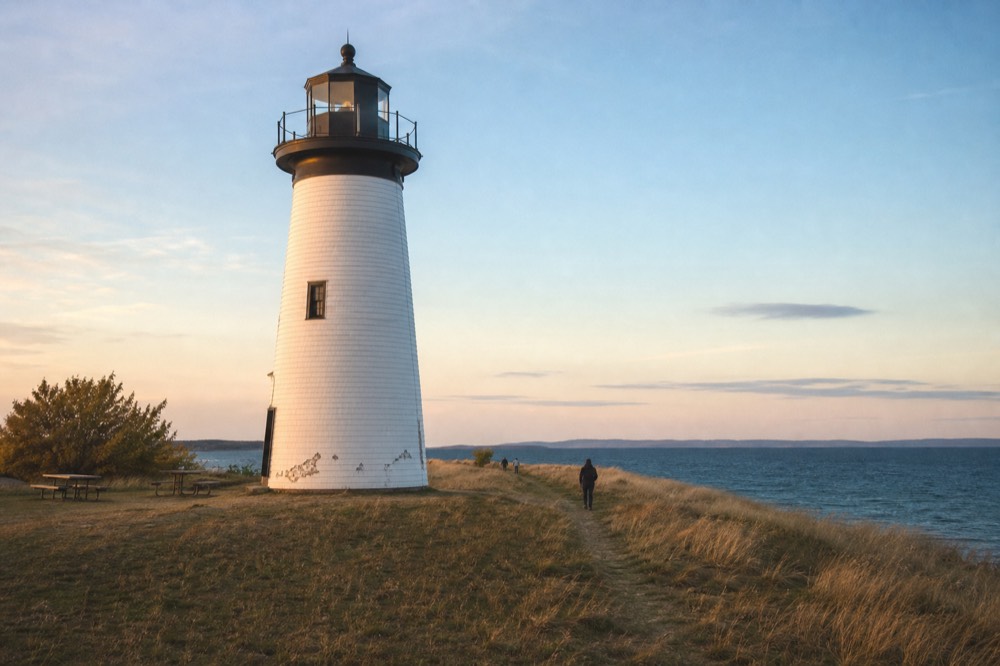
Whatever you choose, treat the drive itself as the main event. Michigan has longer roads, bigger dunes and denser forests, but it has only one peninsula narrow enough to show you two bays at once for nineteen miles, and only one where the scenery fills your glass at the end of it. That is the answer, and it is the reason a site called Traverse City Wine Tours exists at all.
The short answers: M-37 up Old Mission for the two-bay view, M-22 for variety, Pierce Stocking for dunes and the Tunnel of Trees for canopy. The drive takes under an hour each way, October brings the colour, and drinking legally requires a chartered vehicle or a hired driver rather than your own car.
Common Questions About The Most Scenic Drive In Michigan
What Is The Most Scenic Drive In Michigan?
The strongest single case is M-37, Center Road, up Old Mission Peninsula north of Traverse City: 19 miles on a peninsula never more than three miles wide, with bay water on both sides for most of the drive and ten wineries along the way. The Leelanau loop on M-22, the Pierce Stocking Scenic Drive and the Tunnel of Trees are the honest rivals, each better on one dimension and none matching the two-water view.
How long does the drive up Old Mission take?
About 35 to 45 minutes each way without stops. Most travelers spend half a day, adding winery stops, the Old Mission Point park and the lighthouse at the 45th parallel at the tip.
Is M-22 or Old Mission better for a first visit?
M-22 offers more variety, harbor towns and the Sleeping Bear dunes over roughly 100 miles. Old Mission offers concentration: wineries, orchards, two bays and a lighthouse in a compact out-and-back. If wine is the point of the trip, drive Old Mission; if variety is, drive the Leelanau loop.
Can you drink wine on a scenic drive in Michigan?
Only in a chartered vehicle authorized by the state transportation department, which is exempt from Michigan's open-container law under MCL 257.624a(4). In a private car, open alcohol in the passenger area is a misdemeanour, and the OWI threshold is 0.08. A driver who tastes is a driver who cannot legally drive.
When is the best time of year for these drives?
Early to mid October for fall colour, with the peninsulas often holding colour later than inland areas because the bays moderate the air. June and July bring green vines and long light with smaller crowds. October is also the busiest month in the tasting rooms, so book ahead.
Can you take the Manitou Island ferry from the Leelanau loop?
Not in 2026. The National Park Service closed both island docks for reconstruction, so Manitou Island Transit ran no service all season, with a return expected in 2027. Plan the Leelanau loop around the mainland.