Traverse City Wineries With Food: Where To Eat While Tasting On Old Mission
A five-hour wine tour without real food is a long afternoon. A handful of Traverse City wineries have moved beyond the cheese-and-cracker tray, and one tour even pairs estate wines with downtown restaurant stops. Here is where the kitchens are, what they cost, and how to fit a meal into your tasting day.
Short answer
Old Mission Peninsula wineries like Brys Estate sell a $9 wine country snack box, Bonobo Winery pairs wine with sushi at its downtown tasting room, and Black Star Farms runs a pop-up bistro. However, only a few wineries serve anything beyond light snacks, and most tasting rooms are pour-only. The Traverse City Wine & Dine Tour is the only group tour that builds a food stop into its itinerary.
Most Traverse City wineries are tasting rooms, not restaurants. You pour, you sip, you move on. That works for a two-stop afternoon, but a five-hour tour with four wineries and nothing solid to eat is a different story. A handful of Old Mission Peninsula producers have recognized that gap and added real food, from a $9 snack box at Brys Estate to a full sushi pairing at Bonobo Winery's new downtown tasting room. The difference between a winery with a kitchen and one with a sleeve of crackers matters, and it is the reason this guide exists. The Traverse City wine trail is not a place where you can assume every stop will feed you; you need to plan around the few that do. This article names those wineries, lists what they serve and what it costs, and shows how to work a meal into a wine tour day. If you are still mapping out which peninsula to visit, our Old Mission Peninsula wine trail guide covers every stop on the route.
Which Traverse City Wineries Serve Food Beyond A Cheese Plate?
Only a few Traverse City wineries offer food beyond a simple cheese plate. Brys Estate provides a wine country snack box, Bonobo Winery features a sushi bar at its downtown tasting room, and Black Star Farms runs a pop-up bistro (not a walk-in restaurant). A handful of others serve small plates or charcuterie, but most tasting rooms have nothing more than pretzels.
On Old Mission Peninsula, the three wineries with the most food-forward reputations are Brys Estate, Bonobo and Black Star Farms. Brys Estate's wine country snack box is listed on the live tasting room menu at $9, a straightforward box of cheese, crackers, and fruit that pairs with a flight or a glass. Bonobo Winery's food story is newer: in July 2026 the Oosterhouse family opened a tasting room and sushi bar at 115 Franklin Street in downtown Traverse City, in partnership with Dojo Sushi. The Ticker reported the space seats 25 to 30 indoors and has outdoor seating overlooking Grand Traverse Bay. MLive confirmed the Traverse City Commission approved the permits in 2025. The menu pairs Bonobo's estate wines with sushi rolls and small plates, making it the only peninsula winery with a dedicated food concept in town.
Black Star Farms is a different case. Its Bistro Polaris on the Leelanau Peninsula property now runs as a culinary event venue, not a daily restaurant. The winery's own site describes it as a pop-up bistro with weekly dining events, pop-up brunches, seasonal cooking classes and private dinners. A visitor cannot simply walk in for lunch; you need to check the schedule and book ahead. That distinction matters, because many older travel guides still list Bistro Polaris as a full-service restaurant. That changed in 2026, and the difference between a kitchen that is open every day and one that opens for calendar events is the difference between a reliable food stop and a gamble.
Other wineries on Old Mission offer lighter fare. Chateau Chantal occasionally serves small plates or desserts alongside its wine flights, but the menu is seasonal and not published online. Mari Vineyards has a cheese and charcuterie board, and Hawthorne Vineyards sells a small selection of snacks. On the Leelanau Peninsula, Shady Lane Cellars and Rove Estate both have food menus, though they are not the focus of this guide, which is anchored on the Old Mission trail where the majority of tours run. Our Leelanau Peninsula wine trail guide covers those stops in detail. The point is that only a few wineries on either peninsula have a real kitchen, and knowing which ones they are before you book a tour is the difference between a comfortable day and a hungry one.
What Does A Wine Country Snack Box Actually Cost, And What Is In It?
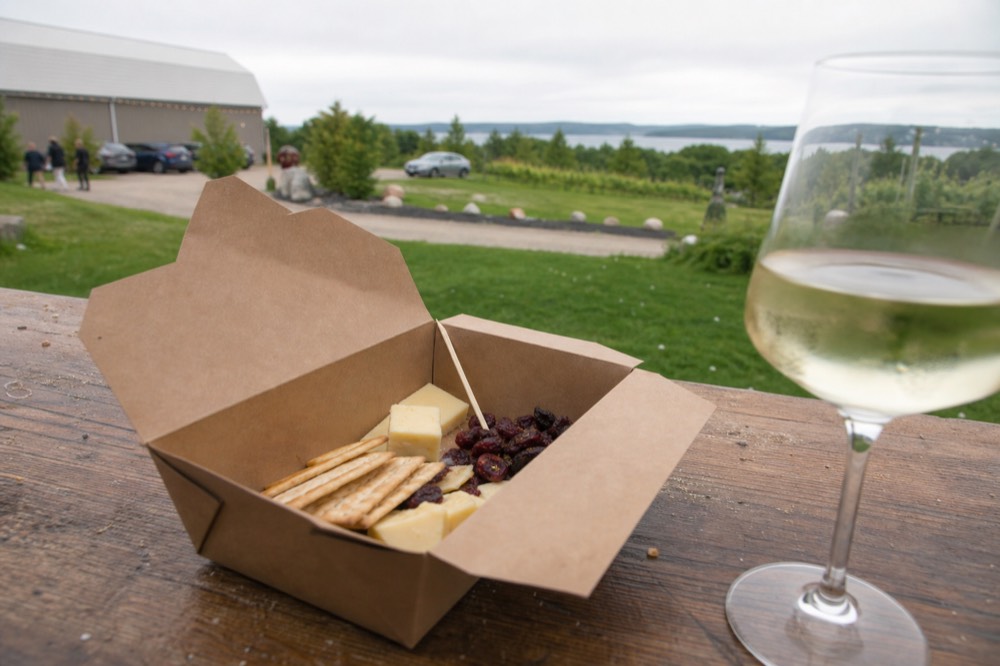
Brys Estate's wine country snack box is priced at $9 on the tasting room menu, and it is the most clearly documented food item on any Old Mission winery list. The box includes cheese, crackers, and fruit, sized for one person to pair with a tasting flight. No other winery on the peninsula publishes a fixed-price food item with this level of specificity, and that transparency is what makes it the most reliable mid-tour bite on the route.
The $9 snack box is not a meal, but it is enough to put something solid in your stomach between two pours. The value is in the transparency: a visitor can plan on it, budget for it, and know it exists before they arrive. Most other wineries that offer food list it as "market price" or "ask your server," which is not helpful when you are building a schedule. The snack box is a small but real differentiator for Brys, and it is the reason the winery keeps appearing in this guide and in our best wineries in Traverse City roundup.
The table below collects the published food offerings at Old Mission wineries where pricing is available, drawn from the live tasting room menus and operator listings. Where a price is not published, the table says so. This is not a restaurant guide; it is a snapshot of what you can eat at the winery itself while you taste.
| Winery | Food item | Published price | Notes |
|---|---|---|---|
| Brys Estate | Wine country snack box (cheese, crackers, fruit) | $9 | One person, paired with a flight or glass |
| Bonobo Winery (downtown) | Sushi rolls and small plates | Varies, menu-driven | Partnered with Dojo Sushi; opened July 2026 |
| Black Star Farms (Old Mission) | Bistro Polaris pop-up events | Event pricing, not daily | Not a walk-in restaurant; check winery calendar |
| Chateau Chantal | Small plates, desserts | Seasonal, not published | Available occasionally, inquire at the bar |
| Mari Vineyards | Cheese and charcuterie board | Market price | Available at the tasting room |
| Hawthorne Vineyards | Light snacks | Varies | Selection limited |
The takeaway is that only one winery on Old Mission publishes a fixed-price food item you can count on without calling ahead. The others are either seasonal, event-based, or priced at the discretion of the server. That does not make them bad stops; it makes them stops you need to research before you go. The snack box is a known quantity, and a known quantity is what a tour day needs.
How Do You Fit A Meal Into A Five-Hour Wine Tour?
To fit a meal into a five-hour wine tour, schedule a lunch stop between your second and third tasting, about two hours in. Many tours include a food break; if yours does not, you must reserve your own at one of the limited winery kitchens. Most tours start at 10:00 or 11:00 a.m., so by 12:30 or 1:00 p.m., you’ll want something solid.
The timing works like this: if your tour does not include a food stop, you have two choices. You can eat at one of the food-friendly wineries on the route, or you can ask the driver to drop you at a restaurant downtown or on the peninsula. The latter only works if you are on a private or designated-driver tour where you control the itinerary. On a shared shuttle, you go where the bus goes. For a full breakdown of how pricing works across different tour types, our wine tour prices guide compares every fare and what is included.
The table below shows a sample timeline for a five-hour tour with a meal break, using the Old Mission loop as the model.
| Time | Activity | Food note |
|---|---|---|
| 10:00 a.m. | Departure | Eat breakfast before you board |
| 10:30 a.m. | First winery tasting | Light snacks only if offered |
| 11:45 a.m. | Second winery tasting | Consider Brys Estate for the $9 snack box |
| 1:00 p.m. | Meal stop | Either a winery with food or a restaurant |
| 2:15 p.m. | Third winery tasting | After lunch, palate is refreshed |
| 3:30 p.m. | Final winery tasting | Dessert or cheese plate if available |
| 4:00 p.m. | Return |
The meal stop is the pivot. If you are on a tour that does not include food, you need to know which winery on the route has a kitchen or a snack box before you commit. The Traverse City Wine & Dine Tour solves this by building the food stops into its itinerary: two wineries, then downtown Traverse City for a food stop. That is the only shared tour that guarantees a meal. For everything else, the burden is on the guest to plan.
Which Wine Tours Include Food, And Which Do Not?
Only the Wine & Dine Tour includes food stops; all other group tours provide transportation and sometimes samples but no meal. If you book any other tour, you'll need to bring or buy your own food, so check which wineries on the route offer kitchens or snack boxes before committing.
The tours on Old Mission divide into three categories. The Magic Shuttle Bus tours are transport-only: you pay the fare, the bus takes you to wineries, and you pay for every tasting and every bite at the bar. The Movie Stars Wine Tours include samples and a complimentary bottle in the ticket price, but food is extra and not part of the package. The Wine & Dine Tour, also run by Movie Stars, is the exception: it explicitly pairs two winery stops with food stops downtown. The table below breaks down the three tours that appear most often in this guide, showing exactly what is covered.
| Tour | Operator | Includes food? | What the fare covers |
|---|---|---|---|
| Traverse City Wine & Dine Tour | Movie Stars Wine Tours | Yes, downtown food stops | Tastings at two wineries, then food stops in town |
| Old Mission 5-Hour Four Winery Tour | The Magic Shuttle Bus | No | Transport only; tasting fees $5–$10 per winery extra |
| Non-Bus Old Mission SUV Tour | Movie Stars Wine Tours | No | Samples and a complimentary bottle; flights and food extra |
The distinction is important because a tour that says "samples included" is not the same as a tour that says "food stops included." Samples are a pour at the bar. Food is a plate at a restaurant. On the Wine & Dine Tour, the itinerary is built around the meal, not the other way around. On the other tours, the itinerary is built around the wine, and food is an afterthought. Book accordingly.
The Wine & Dine Tour is a newer listing and carries no reviews yet, so the live listing is the only place to check the current schedule and availability.
The Winery Kitchen That Changed The Rules
Bonobo Winery's downtown sushi bar is a genuine departure for the Traverse City wine scene. Before July 2026, no peninsula winery had opened a tasting room in the city center with a full food concept. The partnership with Dojo Sushi at 115 Franklin Street created a space where estate wines and sushi share the same table, a combination that would have been unusual in Traverse City a decade ago but now signals where the region is heading.
The winery, run by the Oosterhouse family, partnered with Dojo Sushi to create a space at 115 Franklin Street that seats 25 to 30 indoors and has outdoor seating facing Grand Traverse Bay. The Traverse City Commission approved the permits in 2025, and the opening was targeted for July 2026. The menu pairs Bonobo's estate wines, including Riesling and Pinot Grigio, with sushi rolls, nigiri, and small plates.
The significance is not just that it is different. The downtown location puts a winery tasting room within walking distance of the city's restaurant row, the riverwalk, and the hotels. That changes the logistics of a wine tour day. A visitor can now book a morning tour on Old Mission, return to town, and walk to a winery for sushi and a glass of wine without getting back in a vehicle. It is the first time a peninsula winery has made food the center of its story, not an afterthought. And it shows that the market is moving toward more food-wine integration, a trend that is visible in other wine regions but has been slow to reach northern Michigan. Our guide to wineries with views covers Bonobo's outdoor seating and other scenic tasting rooms if you want to pair the food with a panorama.
A separate development on the Leelanau Peninsula reinforces the trend. The Inn at Black Star Farms was voted the number one Best Wine Country Hotel in the United States in the 2025 USA Today 10Best Readers' Choice Awards, with Chateau Chantal on Old Mission taking second. That means the top two wine country hotels in the country that year were both on the peninsulas outside Traverse City. Both properties have food programs: Black Star Farms with its Bistro Polaris events, and Chateau Chantal with its seasonal small plates. The recognition puts a national spotlight on the region's wine-and-food pairing potential, and it adds weight to the argument that the peninsulas are evolving from a tasting-room destination into a wine-country destination with food at the center.
Where Should You Eat If You Are Not On A Food Tour?
Eat a substantial breakfast before you board, pack a snack if allowed, and plan to hit the Brys Estate snack box on Old Mission Peninsula for a reliable mid-tour bite. If you’re on a private tour, ask your driver to stop at a restaurant on the peninsula or downtown Traverse City.
Most tour operators on the roster allow snacks and water on board, but full meals are not typical. The Magic Shuttle Bus and Movie Stars listings do not explicitly prohibit outside food, but the vehicles are shared and space is limited. Private tours are more flexible, and private groups can build a restaurant stop into the itinerary. If you want to compare the transport options side by side, our wine tour transport guide covers the vehicles, the pickup policies, and the open-container rules that govern what you can drink on board.
Downtown Traverse City has a dense food scene that is covered in more detail on the site's where to eat in Traverse City blog post. That article is the place to answer the broader question of where to eat in town; this guide sticks to the wineries themselves. The sibling blog post covers the city's restaurant openings, closures, and the food scene that earned Traverse City the title of Food City of the Year in Midwest Living's Best of the Midwest Awards for 2026. It is the right resource if you are looking for a dinner reservation after your tour, or a lunch spot before you head out. The point here is simpler: on a wine tour, you eat where the tour stops, or you do not eat. Knowing which wineries have food, and which tours include a stop, is the only way to avoid a hungry afternoon.
What About Leelanau Peninsula Wineries With Food?
Wineries on the Leelanau Peninsula offer a more spread-out food scene with pop-ups, flatbreads, small plates, and seasonal kitchen menus, ideal for self-guided visitors who craft their own itineraries. Notable stops include Black Star Farms’ Bistro Polaris, Shady Lane Cellars’ casual fare, and Rove Estate at Gallagher’s seasonal kitchen.
The Leelanau Peninsula's food scene is less centralized, which reflects the geography. The peninsula is larger and the wineries are dispersed across four sub-regions. Our Leelanau Peninsula wine trail guide walks through every stop on the trail, including the ones with food menus. The majority of Leelanau wine tours are private or semi-private, and the group tours that run on Old Mission do not cross over to Leelanau. A Traverse City Wine Tours guide to Leelanau wineries is available for those planning a day on that peninsula.
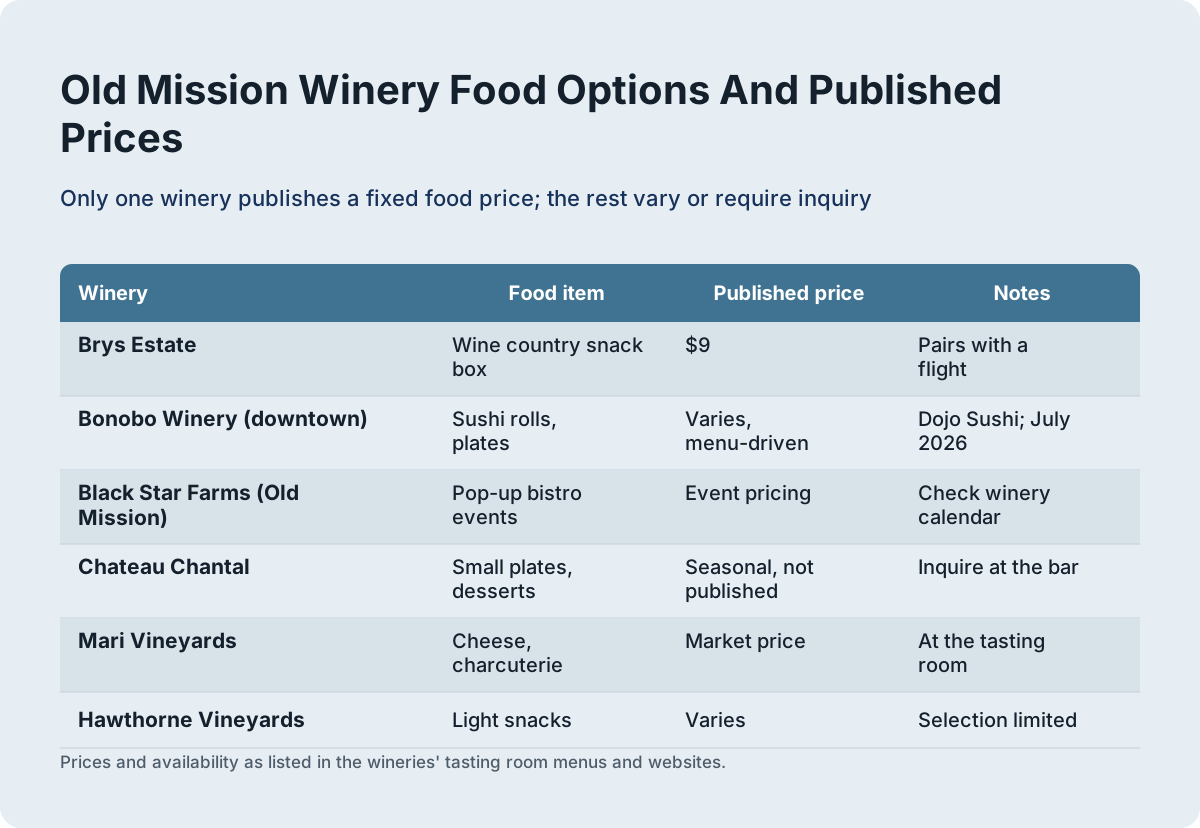
The infographic below summarizes the food landscape across both peninsulas, showing which wineries have a kitchen, a snack menu, or no food at all. It is designed to be a quick reference for anyone building a wine tour day.
How Much Should You Budget For Food On A Wine Tour Day?
For a wine tour day, budget an extra $20 to $40 per person for food beyond the tour fare, unless you book the Wine & Dine Tour where meals are included (only tips extra). The most affordable option is a $9 snack box at Brys, while a sit-down sushi lunch downtown will cost more.
The table below estimates the food cost for a typical day on each of the three main tour types, assuming you eat once mid-tour. The figures are based on the published prices and the tour inclusions. For a deeper look at how tour fares stack up across the entire roster, see our wine tour prices guide.
| Tour type | Tour fare | Food cost (mid-tour) | Total food outlay |
|---|---|---|---|
| Wine & Dine Tour | From $79 per person | Included | $0 (tips only) |
| Old Mission 5-Hour (Magic Shuttle) | From $79 per person | $9–$25 (snack box or small plate) | $9–$25 |
| Old Mission Non-Bus SUV (Movie Stars) | From $69 per person | $9–$25 (snack box or small plate) | $9–$25 |
The budget difference is not dramatic, but the experience is. On the Wine & Dine Tour, you sit down to a meal. On the other tours, you grab a snack box or a cheese plate at a tasting bar. Neither is wrong, but they are different. If you want a proper lunch, book the tour that includes it. If you are happy with a snack, the $9 box at Brys works. The best time for wine tasting guide covers seasonal factors that affect both the crowds and the food availability at winery kitchens.
The Winery Food Scene Is Still Small, And That Is The Point
Because the region’s limited food options are intentional, not a flaw. The handful of wineries with kitchens stand out precisely because the gap is wide, making the experience more about the wine and less about the meal, and the point is a sharper focus on the tasting room.
The most practical advice is to treat food as a separate planning layer. Pick a tour that includes a meal if you want a seamless day. If you are on a transport-only tour, know which winery has the snack box and when you will hit it. And if you are building your own itinerary, the sibling guides on this site cover the wineries with views, the best time for wine tasting, and the winter wine scene, all of which complement the food question. A wine tour day is a series of decisions, and the food decision is the one that makes the difference between a day you remember for the wine and a day you remember for the hunger. The best wineries in Traverse City guide rounds up the top stops across both peninsulas, including the ones with the strongest food programs.
Common Questions About Traverse City Wineries With Food
Do any Traverse City wineries have full restaurants?
No winery on Old Mission or Leelanau operates a full-service restaurant open daily. Black Star Farms runs Bistro Polaris as a pop-up venue with events, and Bonobo Winery has a sushi bar at its downtown Traverse City tasting room. The nearest thing to a winery restaurant is the Bistro Polaris experience, but it is not a walk-in daily option.
Can I bring my own food on a wine tour?
Most tour operators allow snacks and water on board, but full meals are not typical. Check with the operator before you pack a cooler. The Magic Shuttle Bus and Movie Stars listings do not explicitly prohibit outside food, but the vehicles are shared and space is limited. Private tours are more flexible.
What is the wine country snack box at Brys Estate?
The Brys Estate wine country snack box is a $9 item that includes cheese, crackers, and fruit, sized for one person. It is the only fixed-price food item published on an Old Mission winery menu and is available at the tasting room.
Which winery serves sushi?
Bonobo Winery serves sushi at its downtown Traverse City tasting room, 115 Franklin Street, in partnership with Dojo Sushi. The menu pairs estate wines with sushi rolls and small plates. It opened in July 2026.
Is there a winery with a full kitchen on Leelanau Peninsula?
Shady Lane Cellars and Rove Estate have food menus with flatbreads and small plates, but neither is a full restaurant. Black Star Farms on Leelanau runs the pop-up Bistro Polaris. The Leelanau food scene is more spread out and suited to private tours.
Does the Traverse City Wine & Dine Tour include a full meal?
The tour includes food stops at downtown Traverse City restaurants after two winery visits. It is not a single sit-down meal but a series of food stops paired with the winery tastings. The listings describe it as a food-focused tour, and the fare covers the food stops.