What Is The Best Route To See Fall Colors In Michigan?
The best fall color routes in Michigan, built around the two wine peninsulas at Traverse City, with drive times, wine stops, vineyard timing and honest advice on peak color.
What Is The Best Route To See Fall Colors In Michigan?
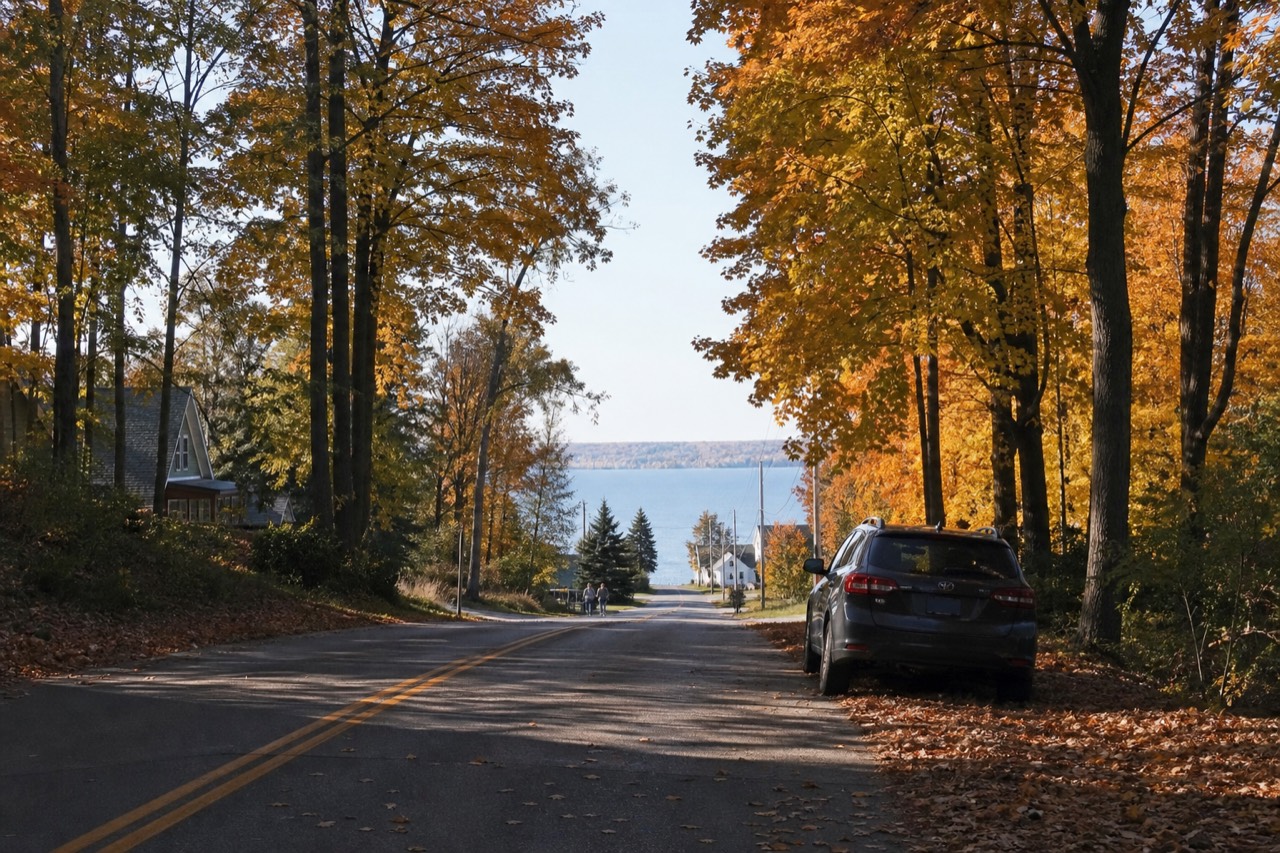
The best route is a loop out of Traverse City across the two wine peninsulas: M-37 up Old Mission to the lighthouse and back, then M-22 up the Leelanau shore through Suttons Bay, Leland and Glen Arbor toward Sleeping Bear Dunes. Together they pack two American Viticultural Areas, bay water on both sides of the road for most of the drive, and dozens of wineries to stop at, into a long weekend.
That is the short answer, and it is the one most northern Michigan drivers would give you. The longer answer is that "best" depends on which weekend you come, because there is no official peak-color date range for Michigan. None exists. The state's tourism bodies, the Michigan DNR and the national parks publish no authoritative week when the color peaks, and any article that names one is inventing it. What is verifiable is this: harvest in the Traverse City wine country runs mid to late September through October, and tasting rooms are busiest in October, because fall color and harvest are the same season here. Color season and the hardest-to-book season overlap completely, which has real consequences for how you plan a route.
The 2026 forecasts themselves disagreed, which tells you how honest any single-date promise would be. The Detroit Free Press and the USA Today Network projected peak color in the northern Lower Peninsula around 20 October, while More Than Just Parks forecast a Leelanau County peak window of 7 to 13 October, and Traverse City Tourism's own guidance says early to mid October, with the peninsulas holding color later than inland areas. That last point matters most: air off the water keeps the shoreline insulated, so the peninsulas keep their leaves after inland Michigan has gone bare. The same mechanism that lets grapes ripen here also extends your color tour.
If you would rather let someone else take the curves of M-22 while you watch the hardwoods, there are tours built for exactly that. These three are the ones worth comparing for a color-season trip:
When Do The Colors Actually Peak, And Why Does Nobody Agree?
Nobody agrees because the date genuinely varies year to year, and no official body publishes a peak-color range for Michigan. Forecasts for 2026 landed anywhere from early October to around 20 October for the northern Lower Peninsula, and Traverse City Tourism's guidance is early to mid October with the peninsulas lingering later than inland areas. Plan for a window, not a week, and build a route that works at any point in it.
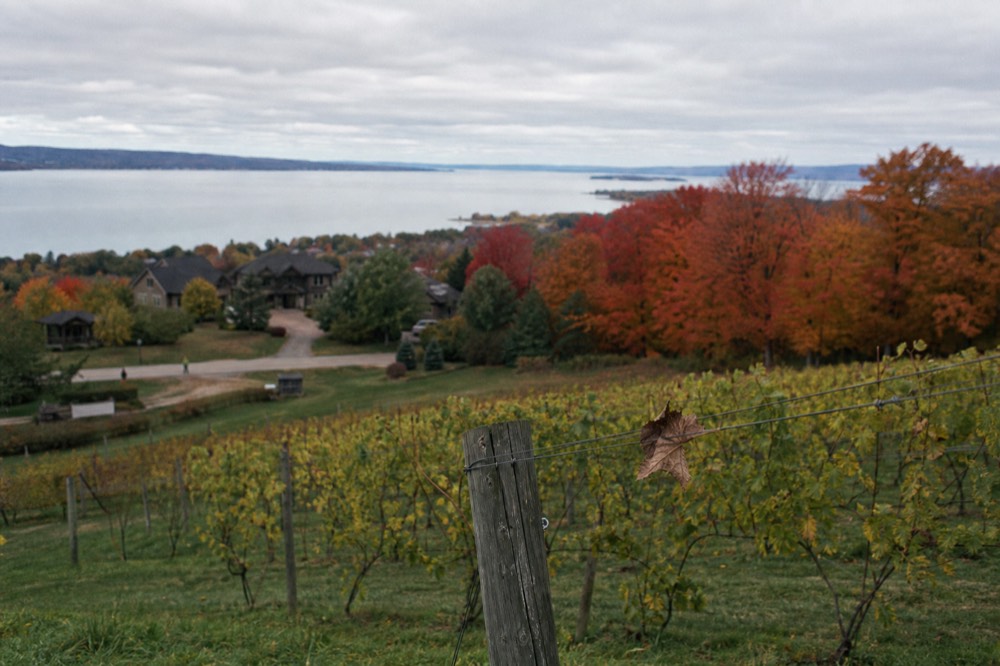
The disagreement among forecasters is not sloppiness, it is physics. Color is triggered by shortening days and then pushed around by temperature and moisture, so a warm September delays it and an early cold snap accelerates it. The bay changes the equation on the peninsulas: water that stored heat all summer keeps the shoreline air mild, so the maples and oaks near the water turn later and hold longer than the same trees ten miles inland. That is why a peninsula route is the safest bet in the state. You are not betting on one week; you are betting on a stretch of shoreline that behaves differently from the rest of Michigan.
There is a second, quieter advantage. Because the water moderates the air, the vineyards stay green and gold long after the hardwoods around them have flared, and the vines themselves turn a coppery red in late October. A color route through wine country gives you two palettes at once: the orange and red canopy above, and the vine rows below, with the whole thing backed by blue water. Inland routes in Michigan give you one of those three layers.
The Best Fall Color Routes In Michigan, Region By Region
Four routes cover the state's best color, and two of them are on the Traverse City peninsulas: the M-37 loop up Old Mission Peninsula, roughly 19 miles each way on a spine no more than three miles wide, and the M-22 drive up Leelanau County through Suttons Bay, Leland and Glen Arbor to Sleeping Bear Dunes. Add the Tunnel of Trees near Harbor Springs, and the Keweenaw Peninsula in the Upper Peninsula for the truly committed.
Here is the honest comparison, with a wine stop on each, because a color drive without a stop is just commuting with better scenery:
| Route | Region | Rough character | Wine or cider stop on the route |
|---|---|---|---|
| M-37, Old Mission Peninsula | Traverse City | 19-mile spine, water on both sides, lighthouse at the end | Chateau Chantal, Bowers Harbor, Brys Estate, Mari, Bonobo, all within minutes of each other |
| M-22 and M-204, Leelanau Peninsula | Traverse City | Long lake-shore drive, harbor towns, dunes at the far end | Black Star Farms near Suttons Bay, Shady Lane Cellars, L. Mawby |
| The Tunnel of Trees near Harbor Springs | Petoskey area | Narrow two-lane under a closed hardwood canopy, no center line for stretches | Wineries thin out; cider and spirits stops around Petoskey and Harbor Springs |
| The highway into the Keweenaw Peninsula | Upper Peninsula | Rock ridges, Lake Superior, the earliest and most dramatic color | Small wineries and cideries around Traverse City this is not; plan it as a pure color drive |
The Old Mission loop is the most efficient color drive in the state. You are never more than three miles from water, the road dead-ends at Mission Point Lighthouse so you cannot get lost, and the wine trail's own map lists ten wineries along the way. One structural note worth knowing: Center Road is the peninsula's single spine, with no alternate route, so a slow leaf-peeper ahead of you sets your pace. That is an argument for going early in the day, or for handing the wheel to someone else.
The Leelanau drive is the big one. M-22 out of Traverse City crosses through Elmwood Township on a stretch that was rebuilt in a $25.8 million reconstruction finished in March 2026, so the road every visitor drives toward the peninsula is new, with a roundabout where the old choke point used to be. From there it runs up the bay through Suttons Bay, Northport, down the Lake Michigan side through Leland and Glen Arbor, and ends in the Empire dunes. In May 2026, a stretch of M-22 crossing Grand Traverse Band of Ottawa and Chippewa Indians land was dedicated as the Company K Indian Veterans 1st Michigan Sharpshooters Civil War Memorial Highway, honoring Native Civil War soldiers; it is one more layer of history on a road that already carries more than most.
If you want the dunes themselves, the Pierce Stocking Scenic Drive inside Sleeping Bear Dunes National Lakeshore is open to vehicles roughly late May until late October, weather depending, and closed to cars but open to walkers outside that window, per the National Park Service. October visitors usually catch it; November visitors usually walk it.
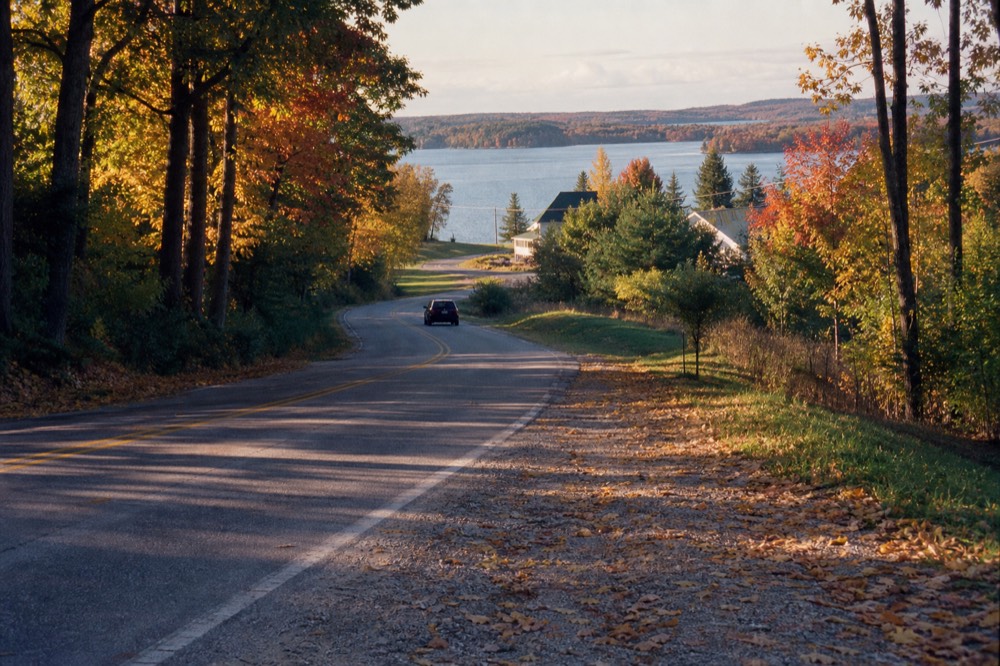
For the Leelanau leg, a scheduled shuttle removes the M-22 stress entirely. The five-hour Leelanau tour run by The Magic Shuttle Bus hits three estates with appointments arranged ahead at each stop, from $79 per person, with tasting fees paid at the wineries. It is rated 4.9 across 427 reviews, and appointments being pre-arranged matters more in October than any other month:
What Is Happening In The Vineyards While The Leaves Turn?
Harvest runs mid to late September through October, with sparkling base fruit picked first, then whites and reds, and Riesling last, which means a color drive in October doubles as a harvest drive. Ice wine grapes are the exception: they stay on the vine and are picked frozen, typically late December into January, when temperatures reach about 15 degrees Fahrenheit.
Color season and crush are the same event here, and the vineyard calendar explains what you will actually see from the road:
| Period | In the vineyard | What it looks like on a color drive |
|---|---|---|
| Mid to late September | Sparkling base fruit comes off first | Vines still green, first hardwood color starting inland |
| Early October | Whites picked, tasting rooms at their busiest | Full canopy color, harvest trucks on the peninsula roads |
| Mid to late October | Reds and finally Riesling picked | Peak color on the peninsulas, vines beginning to turn copper |
| Late December into January | Ice wine grapes picked frozen at about 15°F | A separate trip entirely, and a genuinely winter one |
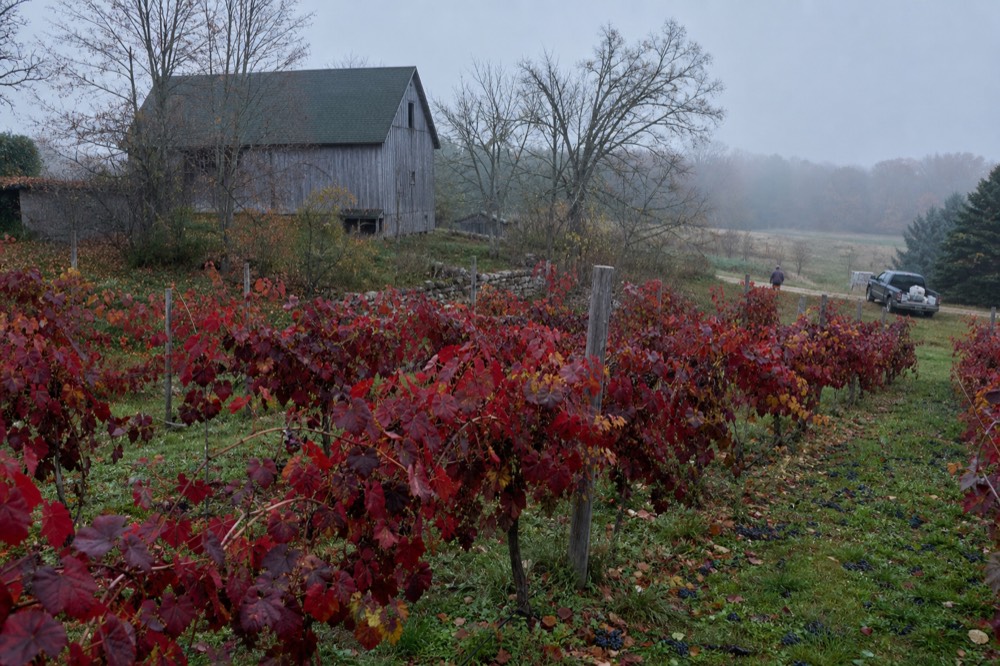
There is a detail here that most color-drive articles miss. The vines themselves are a fall-color crop. Grape leaves run yellow, red and copper in late October depending on the variety, so a vineyard view in the last two weeks of October can be as dramatic as the hardwoods behind it. Riesling, the most-planted wine grape in Michigan at roughly 670 of the state's 3,375 wine-grape acres, is also one of the last things in the field, which is why the latest-picked blocks are often the best-looking ones.
The two peninsulas together produce over 60 percent of Michigan's grapes, per Traverse City Tourism, so this is not a case of a few decorative vine rows beside the road. You are driving through the middle of the state's wine industry at the exact moment it is busiest, which brings up the one thing you should do before you go: book.
Crowds, Reservations And Which Week To Pick
October is the busiest month of the year for Traverse City tasting rooms, because fall color and harvest overlap, so the color weeks are also the reservation weeks. There is no official peak-color date to aim for, so aim for the crowd pattern instead: late September is quiet, early October builds, mid October is the crush, and late October thins out while the peninsulas still hold color longer than inland Michigan.
| Window | Crowd expectation | Why |
|---|---|---|
| Mid to late September | Lightest of the color season | Color starting inland, harvest beginning, schools back in session |
| Early October | Building | First strong color, weekend traffic on M-22 and M-37 |
| Mid October | The busiest tasting-room stretch of the year | Color and harvest peak together; book everything ahead |
| Late October | Thinning, but the peninsulas still hold leaves | Bay-moderated shoreline color outlasts inland color; weekday visits are calm |
The practical read: if you can travel midweek in late October, you get the peninsula color at its most lingered-over with the smallest crowds. If you are locked to a peak weekend in mid October, reservations stop being optional. Tasting appointments, dinner tables and rooms all tighten at once, and the peninsula roads slow to leaf-peeper pace. That is also the strongest argument for a scheduled tour in October: someone else holds the appointments, and the Magic Shuttle Bus listings state plainly that the operator makes appointments rather than leaving you to walk in.
One more October-specific note for Leelanau plans: Manitou Island Transit ran no ferry service to North or South Manitou Island for the entire 2026 season, because the National Park Service closed both island docks for reconstruction, with service expected to resume in 2027. Plenty of older guides still tell you to hop the ferry out of Leland. Check before you build a day around it.
Practical Rules For A Color-And-Wine Drive
Do not drink and drive, know who can legally drink on board, and book the things that sell out. Michigan's open-container law, MCL 257.624a, bans open alcohol in a vehicle's passenger area, with an exception for passengers in a chartered vehicle authorized by the state transportation department. The OWI threshold is 0.08, with zero tolerance under 21, and every tour listing in this market states it is not suitable for under-21s.
That legal distinction has a practical consequence worth understanding before you choose how to tour. The chartered shuttle and SUV tours can advertise drinking on board because they fall under the chartered-vehicle exception. A hired designated driver at the wheel of your own car cannot rely on it, so on that product the drinking happens at the wineries, not between them. The fee structure differs too:
| Operator | Vehicle | Are tastings in the fare? | What you still pay at the bar |
|---|---|---|---|
| The Magic Shuttle Bus | Scheduled limo-style shuttle | No, transport only | $5 to $10 per tasting on Old Mission, $5 to $15 on Leelanau |
| Movie Stars Wine Tours | SUV or Cadillac Escalade | Yes, samples plus a complimentary bottle | Flights and food only |
| Bay Life Getaways | A hired driver in your car | No | Every pour, at every stop |
The drive-your-own-car option is the one color photographers tend to love, because you set the pace, stop where the light is right, and keep the whole route on your own schedule. Bay Life Getaways' designated-driver service runs five private hours in your own vehicle from $369 for the whole group, route of your choosing on either peninsula, rated 4.8 across 187 reviews. Tasting fees are paid at each winery on top:
Beyond the legal and booking questions, three habits make a color drive better. Go early: peninsula light is softest in the first two hours, and the M-37 and M-22 traffic builds fast after mid-morning on October weekends. Fill up before the peninsula: gas is scarce and expensive out on Old Mission and along the Leelanau shore. And check the Sleeping Bear Dunes fees page before you finish the drive at the lakeshore, since entrance applies and fee-free days are listed there.
For a deeper comparison of the two peninsulas as wine destinations, our Old Mission versus Leelanau guide breaks down the differences, and our piece on October in Traverse City covers the month itself. If you are weighing the whole state's scenic drives, start with the most scenic drive in Michigan, and for timing your tasting rather than your leaves, the best time for wine tasting guide has the seasonal detail. The site, Traverse City Wine Tours, exists because this is the one corner of the state where the color drive and the wine country are the same road.
Whichever week you pick, these are the three tours that fit a color-season trip best:
The best base is Traverse City, the best roads are the two wine peninsulas, and the honest answer on timing is a window rather than a week, since no official peak-color date exists for Michigan. The questions below cover the routes, the timing, the crowds and the drinking-and-driving rules in one place.
Common Questions About Fall Color Routes In Michigan
What Is The Best Route To See Fall Colors In Michigan?
A loop out of Traverse City across the two wine peninsulas: M-37 up Old Mission to the lighthouse and back, then M-22 up the Leelanau shore through Suttons Bay, Leland and Glen Arbor toward Sleeping Bear Dunes. Add the Tunnel of Trees near Harbor Springs, or the drive into the Keweenaw if you are touring the Upper Peninsula.
When is peak fall color in Michigan?
There is no official peak-color date range for Michigan, and no state or federal body publishes one. Forecasts for 2026 ranged from a Leelanau peak window of 7 to 13 October to around 20 October for the northern Lower Peninsula, while Traverse City Tourism's guidance is early to mid October. The peninsulas hold their color later than inland areas because the bay moderates the air.
Can you combine a fall color drive with wine tasting?
Yes, and around Traverse City they are the same trip. Harvest runs mid to late September through October, tasting rooms are busiest in October, and the wine trails sit directly on the best color roads. Book tasting appointments ahead in October, because color season and the busiest tasting season overlap completely.
Is M-22 a good fall color drive?
It is one of the best in the Midwest: lake shore, harbor towns, and the dunes at the far end. The stretch through Elmwood Township was rebuilt in a $25.8 million project finished in March 2026, so the road out of Traverse City is new. Expect slow leaf-peeper traffic on October weekends.
Do I need reservations for wineries during fall color season?
In October, yes. Tasting rooms around Traverse City are at their busiest that month, and the shuttle operators themselves arrange appointments rather than relying on walk-ins. Book tastings, dinner and lodging together, especially for mid-October weekends.