How Many Wineries Are Near Traverse City, Michigan?
The honest answer to how many wineries sit near Traverse City: two wine trails publish two different counts, they overlap, and no verified total exists. Here is what the trails themselves say, and how many you can actually visit.
How Many Wineries Are Near Traverse City, Michigan?
There is no verified total, and anyone who prints one is guessing. The Old Mission Peninsula Wine Trail lists ten wineries on its own trail map. The Leelanau Peninsula Wine Trail's member page lists 23, while its own homepage says only "over 20." Black Star Farms belongs to both trails, so adding the two counts double-counts it, and third-party outlets publish numbers that disagree with the trails and with each other.
That bolded paragraph is the whole answer, and it is the answer almost no competing page will give you. Most articles about wine country near Traverse City open with a confident round number: 40 wineries, 30 wineries, "more than 25." Almost none of them say where the number came from, because almost none of them can. The counts circulating online are assembled from trail memberships, licensed producers, and tasting rooms, three different things that measure three different populations.
This site is published by Traverse City Wine Tours, and the job here is reporting, not rounding. So instead of inventing a total, this article shows you the two counts the trails themselves stand behind, explains exactly where they overlap, names the third-party numbers and why they disagree, and then answers the question that actually matters for your trip: how many of these wineries can you realistically visit in one day.
The short version of that last answer: a guided shared tour covers three to four wineries in five hours, a private run covers about the same with the route of your choosing, and a self-guided day in a car tops out around five if you pace yourself. The rest of the article unpacks all of it.
What The Two Wine Trails Themselves Count
The only counts any source stands behind are the trails' own: ten wineries on the Old Mission Peninsula Wine Trail's trail map, and 23 members on the Leelanau Peninsula Wine Trail's winery page, a page whose own homepage hedges to "over 20." Both trails publish these numbers themselves, which makes them the anchor for everything else in this article.
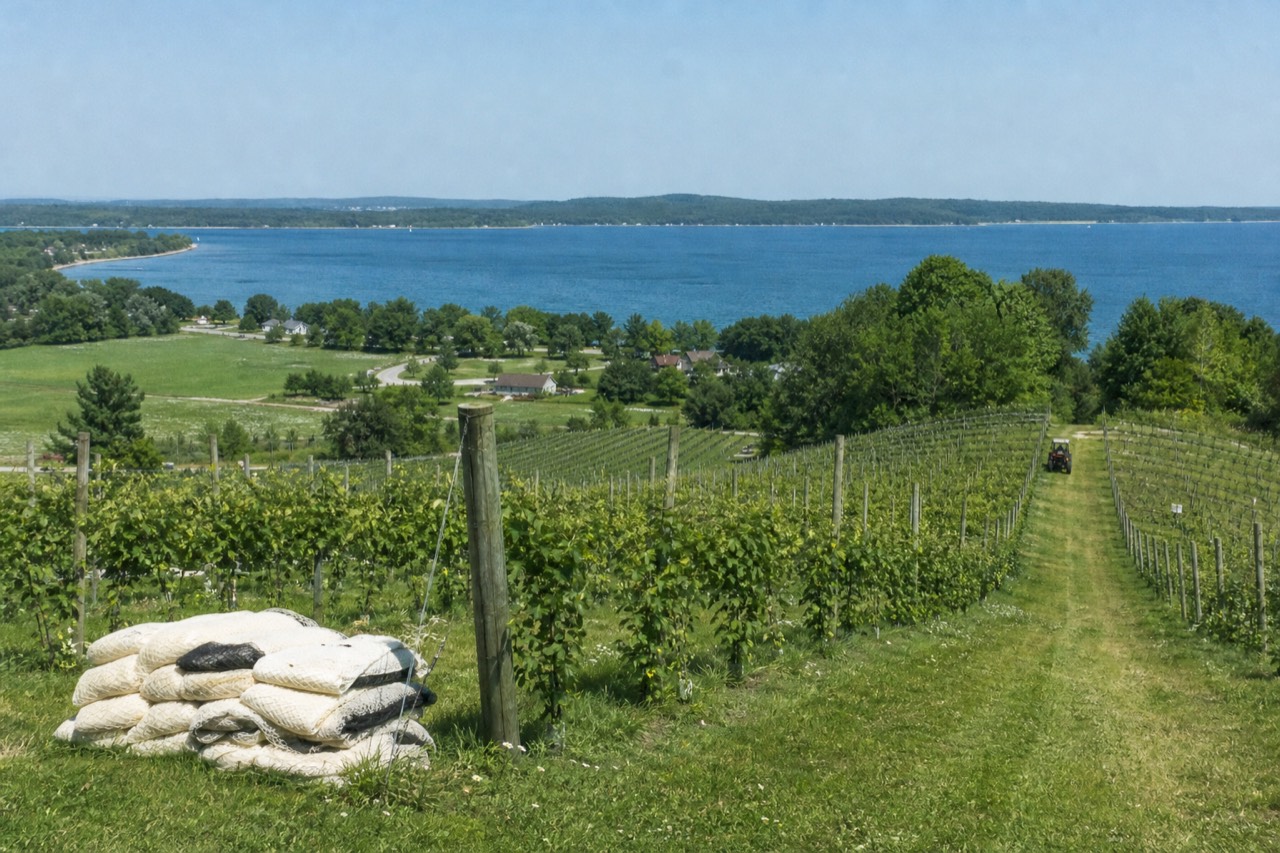
The Old Mission Peninsula Wine Trail is the smaller and tighter of the two. Its trail map lists ten wineries, and the trail's own copy calls them "ten incomparable wineries." The peninsula itself is narrow, no more than three miles wide at any point, running roughly 19 miles north from Traverse City along Center Road, so the trail is effectively one road with ten stops hanging off it. You can read the map yourself on the trail's own trail map page.
The Leelanau Peninsula Wine Trail is the larger and looser organization. Its member page lists 23 wineries, counted directly from the page, ranging from long-established estates like Good Harbor Vineyards and Shady Lane Cellars to newer names like Dune Bird Winery and Soul Squeeze Cellars. Its homepage, though, says only "over 20 award winning wineries," which is the trail hedging its own count. You can see the member list on the Leelanau trail's wineries page.
Here are the two trails side by side, using only their own published figures:
| Trail | Wineries the trail itself lists | Peninsula | AVA established | Geography |
|---|---|---|---|---|
| Old Mission Peninsula Wine Trail | 10, per its own trail map | Old Mission Peninsula | June 8, 1987 (27 CFR 9.114) | All of Peninsula Township plus a small part of Traverse City Township, about 19,200 acres, no more than 3 miles wide |
| Leelanau Peninsula Wine Trail | 23 on its member page, "over 20" on its homepage | Leelanau Peninsula | March 30, 1982 (27 CFR 9.40) | All of Leelanau County excluding the offshore islands, five years older as an AVA and larger |
Two things in that table deserve a pause. First, Leelanau's AVA was established in March 1982, five years before Old Mission's, which makes it one of Michigan's first federally recognized wine regions. Second, and more important for the counting question: the Leelanau AVA is legally the whole of Leelanau County minus its islands, which is a far bigger footprint than the wine trail's membership. Wineries exist inside the AVA that are not on the trail, and that gap is one of the main reasons third-party counts disagree.
If you are planning around the trails rather than the arithmetic, the practical guides on this site break down each one in detail: the Old Mission Peninsula wine trail and the Leelanau Peninsula wine trail.
Why Every Round Number Online Disagrees
Published third-party counts range from 21 to more than 40 wineries for the same region, and they disagree because they are counting different things: trail membership, licensed producers, or physical tasting rooms. Eater Detroit says 23 on Leelanau and 11 on Old Mission, Travel + Leisure says over 40 across both, and a third outlet says 10 and "25 or more." None of these is wrong so much as measuring a different population.
The disagreement is not a mystery once you look at what each outlet counted. Eater Detroit, writing in October 2025, said Leelanau had grown to 23 wineries and Old Mission to 11. That 11 for Old Mission is one more than the trail's own 10, which almost certainly means the outlet counted a licensed producer or tasting room that is not a trail member. Travel + Leisure, in November 2025, said the two peninsulas together hold over 40 wineries, with Leelanau at 28, a figure that likely includes producers well beyond the trail's 23. My Michigan Beach and Travel, in March 2026, said Old Mission has 10 across an 18-mile drive and Leelanau has 25 or more across three loops.
Here is the honest way to hold all of that:
| Source | Old Mission count | Leelanau count | What it appears to be counting |
|---|---|---|---|
| Old Mission Peninsula Wine Trail | 10 | not stated | Its own trail membership |
| Leelanau Peninsula Wine Trail | not stated | 23 members, "over 20" on its homepage | Its own trail membership |
| Eater Detroit, October 2025 | 11 | 23 | Trail members plus at least one non-member producer |
| Travel + Leisure, November 2025 | over 40 combined | 28 | All licensed producers and tasting rooms it could verify |
| My Michigan Beach and Travel, March 2026 | 10 | 25 or more | A mix, with Old Mission matching the trail |
Notice that even the two trails' own numbers are not perfectly stable: the Leelanau trail's member page and its homepage give different framings of the same roster. That is normal for a membership organization, wineries join and lapse, but it is exactly why a page that prints "Traverse City has 40 wineries" with no source is not giving you information. It is giving you a rounded memory of someone else's rounded number.
There is also a category problem underneath all of this. Michigan has 279 wine producers statewide according to the 2025 WineAmerica economic impact study, published via the Michigan Wine Collaborative. But "producer" is a license category, not a place you can drive to. Some producers share facilities, some sell only through other people's tasting rooms, and some are cider houses or meaderies that appear on wine trails anyway. A count of producers, a count of trail members, and a count of doors you can walk through on a Saturday are three different numbers, and no amount of rounding turns one into another.
The Black Star Farms Problem: Why You Cannot Just Add The Trails
Adding the two trails' counts produces a number that overstates the region by exactly one winery, because Black Star Farms is a member of both trails. It operates a Suttons Bay tasting room on Leelanau and a second tasting room on Old Mission, so anyone who adds the trail counts together without checking has double-counted a single winery business.
This is the single most common arithmetic error in every "how many wineries" answer you will find, and it is worth slowing down on because it explains why the region feels both bigger and smaller than the numbers suggest.
Black Star Farms is a Leelanau operation at its root: its main estate is at 10844 E Revold Road in Suttons Bay, with tasting room hours of 11am to 6pm Sunday to Thursday and 11am to 8pm Friday to Saturday. But it also pours on Old Mission, at 360 McKinley Road E, with hours of 11am to 6pm Sunday to Thursday and 11am to 7pm Friday to Saturday, per its own site. Because it has a real presence on both peninsulas, it appears on both trails, and both trails are right to list it.
So the honest arithmetic is:
- Old Mission trail members: 10
- Leelanau trail members: 23
- The naive sum of the two trail counts, which is what most pages print
- Black Star Farms, which must be counted once, not twice
- A distinct-winery total that is one lower than the naive sum
And even that corrected figure is only the trail-member count, not the total of wineries near Traverse City. It excludes licensed producers that are not trail members, it excludes the urban winery inside Traverse City proper, Left Foot Charley, which sits in the city rather than on either peninsula, and it excludes tasting rooms that pour multiple producers' wines under one roof. If a page tells you the region has exactly this many or exactly that many wineries, it has stopped one step short of the truth and then rounded.
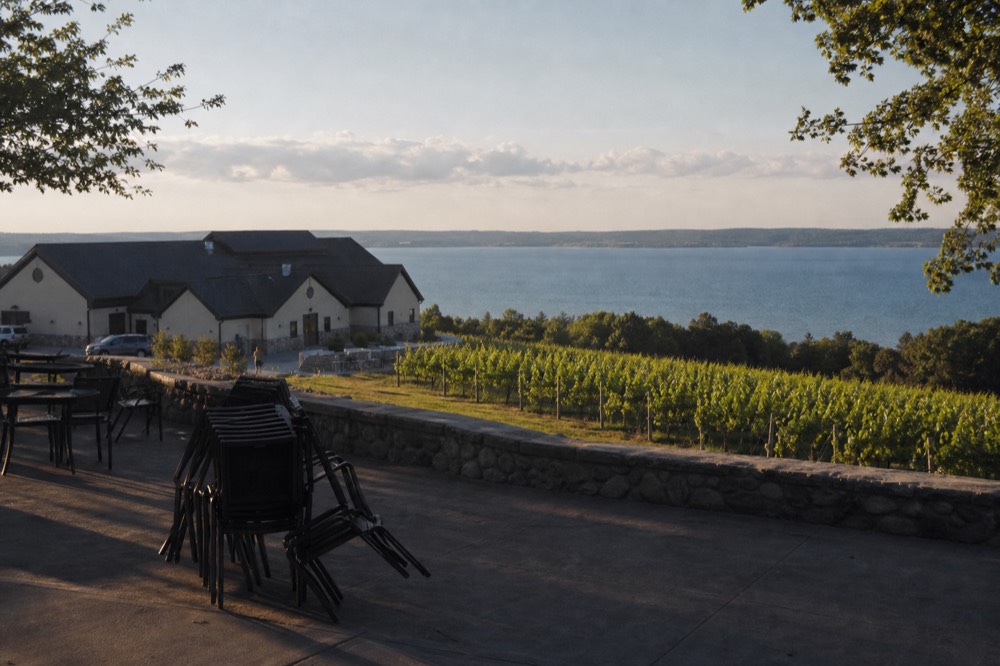
The comparison that follows from all this is not really about counts, it is about character: ten stops on one narrow road with bay water on both sides, against 23 spread across a whole county's worth of loops and villages. The site's Old Mission versus Leelanau comparison works through that choice in full.
How Many Wineries Can You Actually Visit In A Day?
A shared guided tour visits three or four wineries in roughly five hours. A private tour covers about the same number because tasting rooms pace visits at 45 minutes to an hour, whether or not you control the route. A self-guided driving day tops out around five wineries, and pushing past that is where wine country days stop being enjoyable.
This is the question the count was always a proxy for. Nobody asks "how many wineries are near Traverse City" out of curiosity about arithmetic; they ask it because they are trying to figure out how many they can see. And the answer to that is governed not by the supply of wineries, which is plentiful, but by the physics of a tasting day.
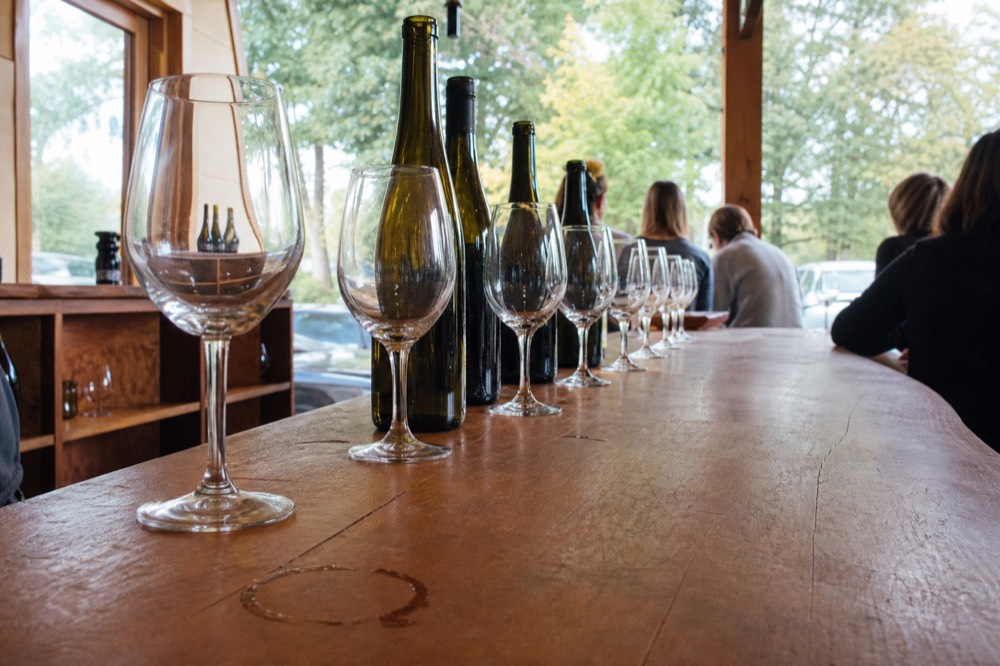
A tasting room visit is not a five-minute stop. You park, you walk in, you wait for a spot at the bar, you work through a flight of several pours, you talk to the pourer, you maybe buy a bottle, you get back in the vehicle. Realistically that is 45 minutes to an hour per winery, plus 15 to 20 minutes of driving between stops on Old Mission and often more on Leelanau, where the trail spreads across three separate loops. Five hours of touring, minus lunch, gives you four stops comfortably.
The tour formats available in this market, and what each one realistically covers:
| Format | Hours | Wineries per day | What the ticket covers | Typical from-price |
|---|---|---|---|---|
| Shared shuttle tour, Old Mission | 5 | 4 | Transport only; tastings paid at each winery, generally $5 to $10 per stop | $79 per person |
| Shared shuttle tour, Leelanau | 5 | 3 | Transport only; tastings paid at each winery, generally $5 to $15 per stop | $79 per person |
| Semi-private SUV tour, either peninsula | 4 to 5 | 3 to 4 | Samples plus a complimentary bottle included; flights and food extra | $69 per person |
| Private tour, your group, your route | 4 to 5 | 3 to 4 | Vehicle and driver; tastings almost always paid separately | $369 to $699.99 per group |
| Self-guided, your own car | 6 to 8 | 4 to 5 | Nothing but your fuel; every tasting fee paid at the bar | tasting fees only |
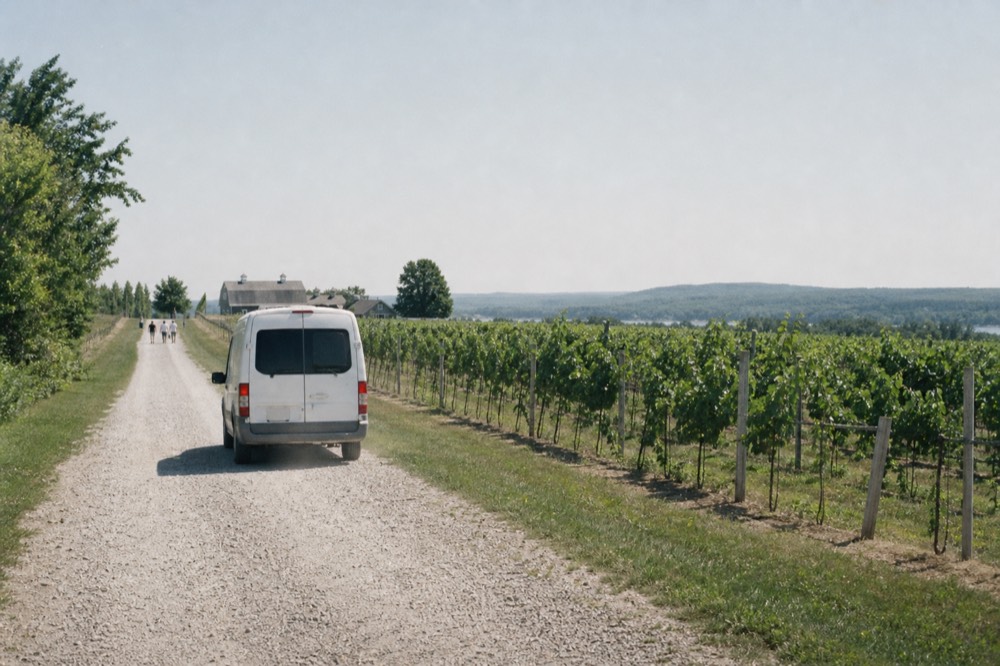
Notice that the private formats do not buy you more wineries, they buy you control. A private run still moves at the pace of the tasting rooms. What you get is the route of your choosing, the wineries you specifically wanted, and no strangers' preferences in the mix. The Private Traverse City Winery or Brewery Tour run by The Magic Shuttle Bus is the clearest example: four private hours for up to 14 people, from $699.99 for the whole group, with wineries, breweries, or a mix chosen by the group and tasting fees separate. It is rated 4.9 across 37 reviews.
For travelers who would rather not plan a route at all, the shared formats do the choosing for you. The 5-Hour Traverse City Wine Tour covering four wineries on Old Mission Peninsula is the market's most-reviewed product, rated 4.9 across 2,666 reviews, from $79 per person with tasting fees paid at the bar. Its Leelanau counterpart covers three estates in five hours, rated 4.9 across 427 reviews at the same from-price, with appointments arranged ahead at each stop.
One planning note that matters more than any count: the two operators in this market structure their tickets differently, and it changes your budget. The Magic Shuttle Bus tours include transport only, so you pay $5 to $10 per tasting on Old Mission or $5 to $15 on Leelanau at each stop, on top of the ticket. Movie Stars Wine Tours includes samples plus a complimentary bottle in the fare, with flights and food extra. A four-stop day can differ by $20 to $40 per person in tasting fees depending entirely on which operator you book, and the site's wine tour prices guide works that arithmetic out in full.
Does The Total Even Matter For Your Trip?
No, and it is worth being blunt about it. Whether the true number is the trail-member count, the 40-something producers Travel + Leisure cites, or "over 20" on a homepage, you will visit three to five of them, and the difference between a great day and a mediocre one is which three to five, not how many exist. The count is trivia; the selection is the trip.
Think about what actually varies between the peninsulas. Old Mission gives you ten wineries on a single 19-mile road, bay water visible from most of them, and a day that feels like one long linear tour with no route decisions to make. Leelanau gives you 23 trail members spread across a county, clustered around Suttons Bay, Lake Leelanau, and the M-22 corridor, with villages and pie shops and a lighthouse mixed in, and a day that rewards planning. Those characters are described in full in the site's best wineries in Traverse City guide.
The count question also hides a seasonality point that matters more. Harvest runs mid to late September through October, tasting rooms are busiest in October when harvest and fall colour overlap, and the Leelanau trail's own Toast the Season event runs over two November weekends with small pours and food pairings at participating wineries. A four-stop day in quiet May feels completely different from the same four stops in peak October, when you may wait for a bar spot at the most popular rooms. If you are choosing when to go, the best time for wine tasting guide covers that trade directly.
And if the answer to "how many" is really "which ones," the honest framing is this: pick a peninsula, pick three to four wineries with a mix of styles, book a format that matches your budget and group, and leave the census to the statisticians. The region's two AVAs together produce over 60 percent of Michigan's grapes, per Traverse City Tourism's own regional page, so whichever three to five you choose, you are drinking from the core of the state's wine industry either way.
The short answers: the trails publish ten and 23, the overlap is Black Star Farms, no verified grand total exists, and a realistic day covers three to five wineries. The questions below restate the details behind each of those points.
Common Questions About Wineries Near Traverse City
How Many Wineries Are Near Traverse City, Michigan?
There is no verified total. The Old Mission Peninsula Wine Trail lists ten wineries on its own trail map, the Leelanau Peninsula Wine Trail lists 23 members while its homepage says "over 20," and Black Star Farms belongs to both trails, so the two counts cannot simply be added. Third-party outlets publish figures from 21 to over 40, each counting a different thing.
Can you add the two wine trails' counts together?
Not directly. Black Star Farms is a member of both trails, with a Suttons Bay estate on Leelanau and a second tasting room on Old Mission, so the naive sum double-counts it. Correcting for that overlap gives a distinct-winery figure one lower than the sum, and even that excludes non-member producers and the urban winery inside Traverse City itself.
How many wineries can you visit in one day near Traverse City?
Three to four on a guided tour of roughly five hours, and four to five on a self-guided driving day if you pace yourself. Tasting room visits run 45 minutes to an hour each, plus driving between stops, so the limit is time and pacing, not the supply of wineries.
Which peninsula has more wineries, Old Mission or Leelanau?
Leelanau, by a wide margin. Its wine trail lists 23 member wineries spread across the county, while Old Mission's trail lists ten on a single narrow peninsula. Old Mission's ten are far more compact, all reachable along one roughly 19-mile road, which makes it the easier peninsula for a first visit.
Why do websites give different winery counts for Traverse City?
Because they count different things. Trail membership, licensed wine producers, and physical tasting rooms are three different populations, and outlets mix them. Michigan has 279 wine producers statewide per the 2025 WineAmerica study, but a producer is a license category, not necessarily a tasting room you can visit, so producer counts never translate cleanly into winery-day planning.